

The telecom industry moves in long cycles. By the time one generation reaches wide deployment, research on the next generation has already started. Today, operators in many countries are still improving 5G networks while 5G Advanced continues to grow. At the same time, research groups, universities, and telecom companies are working on 6G ideas. Beyond that, a small number of researchers have started discussing what may come after 6G — commonly referred to as 7G. So, now let us look into 7G Networks What Early Research Suggests and What It Could Mean for Mobile Network Testing along with Accurate LTE RF drive test tools in telecom & Cellular RF drive test equipment and Accurate Wireless Survey Software Tools & Wifi site survey software tools in detail.
At this stage, 7G is not a standard. There are no commercial deployments, no agreed specifications, and no fixed timeline. Most of the discussion comes from research papers and concept studies. Even so, these early ideas are useful because they give a direction for how mobile communication systems may evolve over the next 15 to 20 years.
A simple way to think about 7G is this: researchers expect networks to become more intelligent, more automated, and more connected across different communication systems.
One common idea in many papers is that future networks may no longer depend only on towers and terrestrial radio systems. Today, mobile networks mostly rely on cell towers, fiber backhaul, and radio equipment spread across cities and rural areas. Future generations are expected to combine cellular networks with satellites, drones, high-altitude platforms, and edge computing systems.
In practical terms, a mobile user may move between different layers of connectivity without noticing it. A smartphone, router, IoT sensor, or autonomous device may switch between terrestrial and non-terrestrial networks depending on signal conditions, traffic demand, cost, and application requirements.
This creates an interesting technical challenge.
How do operators test and monitor a network when coverage no longer depends only on towers?
Traditional drive testing mainly focuses on radio measurements collected from terrestrial networks. Engineers study coverage, signal quality, throughput, latency, mobility performance, handovers, voice quality, and user experience metrics. If future networks combine multiple communication layers, testing will also need to evolve.
For example, consider a future transport route involving trains, ships, or aircraft. Connectivity may move between cellular coverage, satellite links, and private wireless systems. In such situations, testing cannot stop at signal strength measurements alone. Engineers will need to understand service continuity, application behaviour, switching delays, voice performance, video stability, and customer experience across different network layers.
Another repeated topic in early 7G discussions is artificial intelligence.
Today, AI is already being introduced into telecom operations for alarms, optimisation, and analytics. Future generations may move further in this direction. Research papers describe networks that continuously observe behaviour, learn from traffic patterns, predict failures, and adjust parameters automatically.
In a future system like this, network optimisation may become more predictive rather than reactive.
From a testing point of view, this changes how engineers collect data.
Today, many drive tests happen during troubleshooting, benchmarking exercises, regulatory measurements, acceptance testing, or periodic optimisation work. Future systems may rely more on continuous measurements rather than isolated testing campaigns.
This means testing tools may shift toward always-on monitoring.
Instead of saying, “Let us perform a drive test next week,” operators may continuously collect quality measurements from fixed probes, smartphones, IoT devices, routers, enterprise systems, and customer equipment.
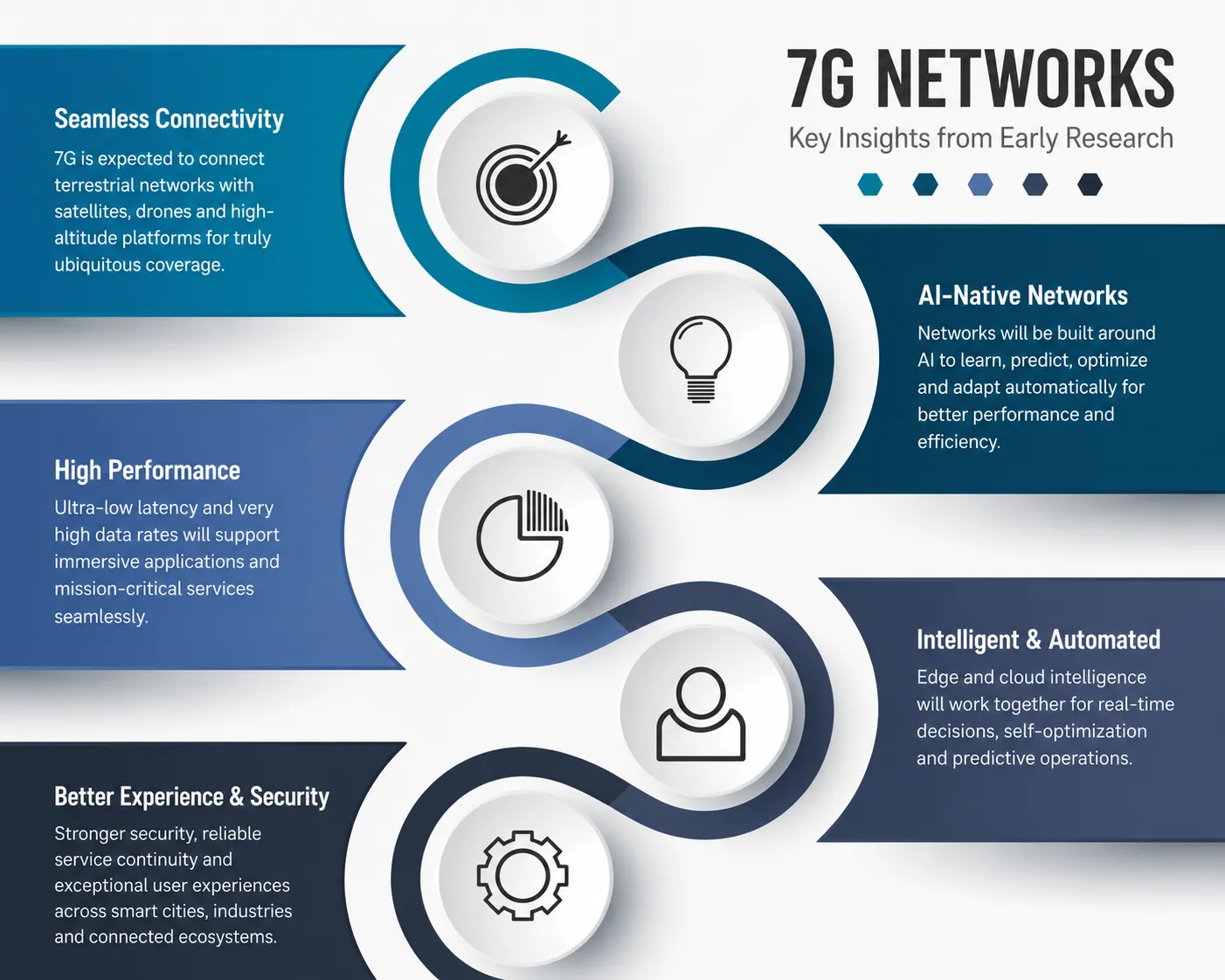
The infographic highlights how 7G research envisions smarter, AI-native networks with better connectivity, faster performance, automation, and stronger user experience.
The network may then use these measurements to trigger actions automatically.
For example:
• Detect voice quality degradation in one district
• Identify unusual latency increases near transport corridors
• Detect mobility failures during peak hours
• Compare performance between operators automatically
• Predict where signal quality may drop before customer complaints rise
This may increase the role of crowdsourced and distributed measurements.
Smartphone-based measurements may become more useful because future networks are expected to depend strongly on user experience visibility. Laboratory testing alone cannot fully represent real-world behaviour. Operators will still need measurements collected from roads, offices, homes, airports, trains, campuses, factories, ports, and remote locations.
Another topic seen in some 7G research is network automation.
Future systems may rely more on automated workflows where measurements are scheduled, collected, uploaded, analysed, and converted into reports without manual effort.
This matters because network complexity continues to increase.
| Category | 5G (Today) | 6G (Expected) | 7G (Vision) |
| Network Coverage | Tower-based mobile network | Tower + satellite support | Global terrestrial + satellite + aerial systems |
| AI Role | Supportive analytics | Deep AI integration | AI-native and self-optimizing |
| Automation | Partial automation | High automation | Fully autonomous operations |
| Latency | ~10–20 ms | <1 ms | Near real-time (<0.1 ms vision) |
| Peak Data Rate | Multi-Gbps | 100 Gbps–1 Tbps | 1–10 Tbps (research vision) |
| Testing Model | Drive tests + periodic testing | Automated testing growth | Continuous always-on monitoring |
| Data Sources | Smartphones + probes | Multi-device ecosystem | Smartphones, IoT, vehicles, satellites, probes |
| Network Intelligence | Reactive troubleshooting | Predictive analytics | Self-learning and predictive operations |
| QoE Focus | Network KPIs + user tests | Greater QoE visibility | Real-time experience assurance |
| Security | Standard encryption | AI-assisted security | Adaptive / quantum-safe concepts |
| Service Continuity | Good | Very high | Always-on seamless connectivity |
| Main Telecom Goal | Faster mobile broadband | Intelligent connectivity | Autonomous network experience |
The table shows how networks may evolve from 5G to 7G with more AI, automation, better connectivity, and stronger user experience.
A single operator may manage public networks, enterprise private networks, IoT deployments, fixed wireless access systems, satellite links, and temporary event infrastructure. Manual troubleshooting becomes harder when thousands of locations require monitoring.
Automation helps reduce testing effort and increases repeatability.
For example, a future monitoring system may schedule tests automatically every few hours, compare KPIs against thresholds, detect anomalies, and alert teams if performance drops below expected limits.
From a Quality of Experience point of view, this direction also makes sense.
Historically, telecom performance focused heavily on radio measurements. Signal bars, throughput, coverage maps, and radio KPIs received a lot of attention. Those remain useful, but customer perception often depends on something much simpler.
- Can the user make a stable call?
- Does the application respond quickly?
- Does video stream smoothly?
- Does web browsing work consistently?
- Can messaging and business applications work without delay?
Future testing systems may place even greater focus on experience metrics instead of isolated RF values.
For telecom vendors and operators, this may create a stronger need for practical monitoring systems that are easy to deploy at scale.
Research papers often describe future intelligence, but intelligence still depends on measurement data. Without data from real devices and real locations, prediction systems become weak.
This means future telecom testing may require:
• Continuous QoE monitoring
• Automated KPI collection
• Hybrid terrestrial and satellite visibility
• Real-world customer experience measurements
• Faster anomaly detection
• Easier large-scale deployment models
Of course, there is still uncertainty.
Many concepts discussed under the name 7G may never become commercial reality. Some ideas may instead become part of 6G evolution. Telecom history shows that not every research topic becomes a deployed product.
Still, the discussion itself is useful.
It shows where engineers and researchers believe communication systems are heading: greater automation, stronger intelligence, better service continuity, and deeper visibility into customer experience.
The biggest lesson from current 7G discussions may be quite simple.
Future mobile networks are likely to become harder to manage manually. As network complexity grows, operators will need more automation, more measurements, and better visibility into real-world user experience.
Whether it is called 6G, 7G, or something else, one thing looks clear — future networks will need continuous testing, practical analytics, and systems that help teams understand service quality without waiting for customers to report problems.
About RantCell
RantCell is an app-based mobile network testing and QoE monitoring platform for 4G, 5G, private LTE/5G, CBRS, and Wi-Fi networks. It supports drive testing, indoor walk testing, benchmarking, automation, and continuous network monitoring using standard Android devices with cloud-based dashboards, automated reporting, and real-world user experience insights. Also read similar articles from here.